


















Custom audio system balances speech clarity, liturgical music and architectural beauty
By rethinking its audio infrastructure with Morgan Sound and NEXO, ECC built a scalable, volunteer-friendly worship platform that ensures consistent sound, operational simplicity and long-term ministry success.
For many houses of worship, a technology upgrade begins with a familiar question: What needs to be replaced?
At Evangelical Chinese Church (ECC) in Washington State, the question was different. What would it take to make the technology disappear? For volunteer technical leader Nathan Goh, that became the guiding idea behind a sweeping modernisation of the church’s sanctuary. “We came up with this vision of us having a distraction-free worship,” Goh recalls. “Our mission was how can we create a space where we don’t have any distractions?”
That simple idea ultimately drove a project that reached far beyond loudspeakers.
ECC upgraded its lighting, networking and operational infrastructure with an eye toward something more ambitious than solving today’s problems.
“We’re not trying to buy a solution for tomorrow, but for 20 years down the line,” Goh says.
“We wanted to set us up for the future.”
The result is a worship environment built not around a single service, a single musical style or even today’s technical team – but around the people who will use the room for years to come.
One room. Three congregations. One shared experience.
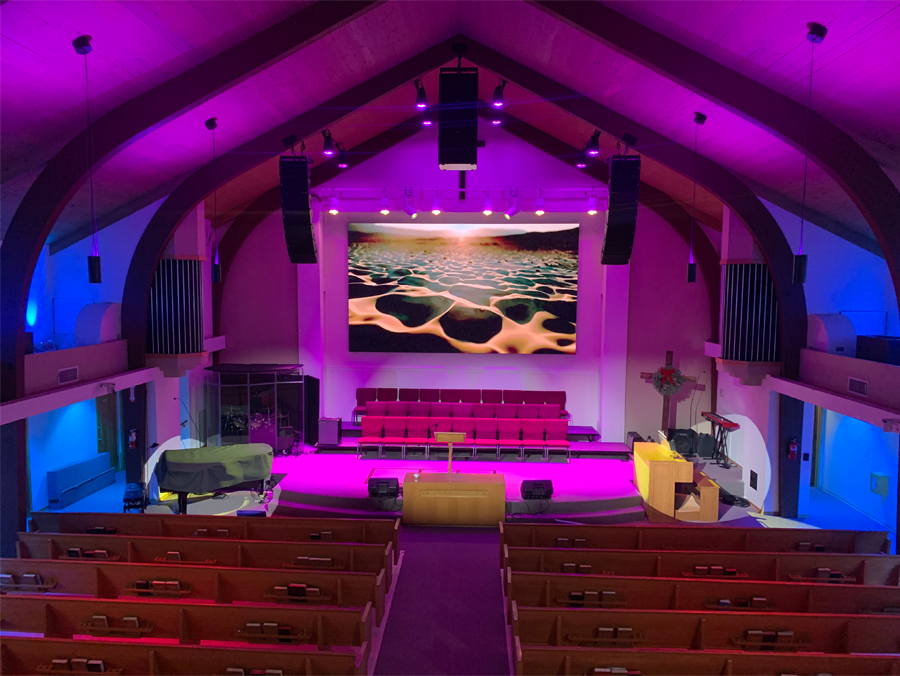
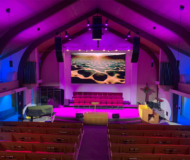
ECC’s sanctuary has to do something few worship spaces are asked to do: transform itself repeatedly without missing a beat. The English congregation leans toward contemporary worship, with drums, bass, guitars and modern production. The Mandarin congregation draws more heavily on choir, organ, grand piano and traditional hymns. The room doesn’t get rebuilt between services, and “we actually have another Cantonese congregation that meets in a separate building,” Goh adds.
“We have basically two services in the space,” Goh explains. “We’ll have the English service and then we’ll have a very quick transition time.”
Breaking the cycle
The need for a new approach became obvious over time. ECC’s production environment had grown organically, with equipment and solutions added whenever a problem surfaced. Eventually, that approach had reached its limit. “For a long time, our church has been kind of under this band-aid solution where we’ve been trying to fix things as we go,” Goh says.
“We were never taking the time to reset.”
The consequences were particularly noticeable in the sanctuary. “It’d be very loud in the front, very quiet in the back, and then very quiet in the balcony,” Goh recalls. “It would be really hard to get the same experience for everyone in every seat.”
Lawrence Tan remembers just how unpredictable the room could be.
“The frequency response would just be completely different depending on where you were standing.” The problem wasn’t that the church lacked equipment. It was that the system had evolved without the opportunity to step back, examine the room as a whole and design around what ECC actually needed.
This time, they decided to reset.
Designing around the room
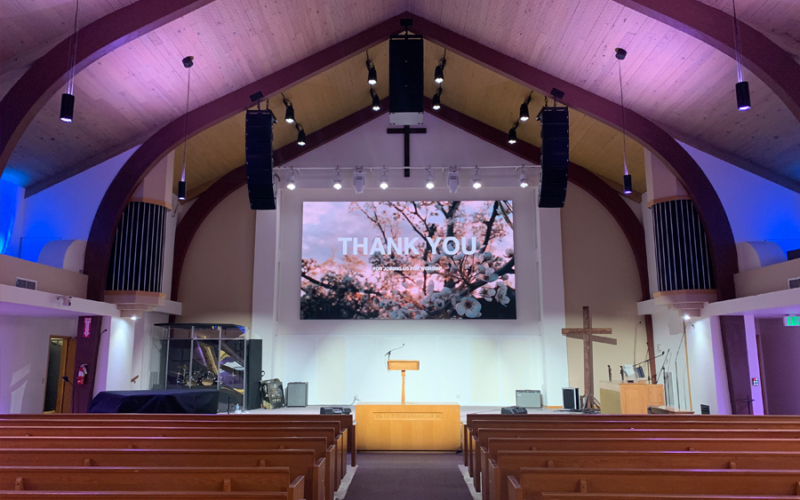
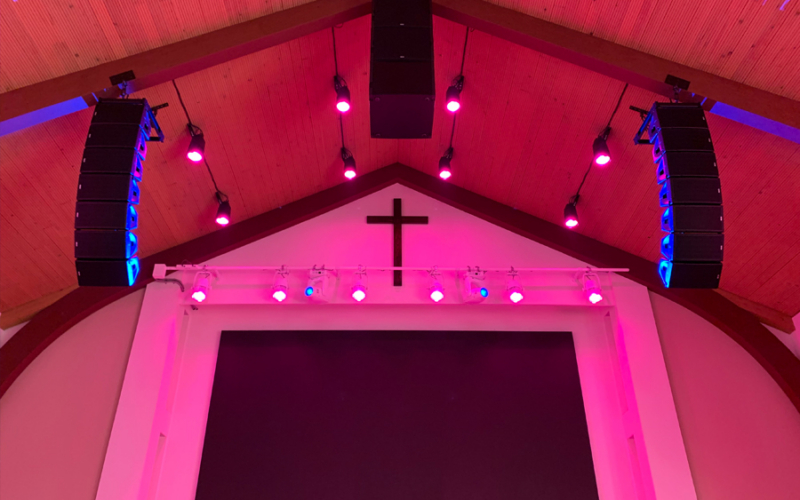
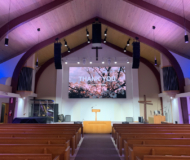
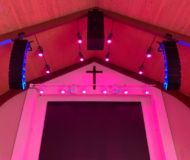
The sanctuary presented its own set of challenges as ECC wanted to ensure the loudspeakers did not impede visibility or obstruct the view of the cross behind the platform.
“One of the challenges in this install was that they wanted the speakers flown as high as possible for sightline reasons,” says Morgan Sound A/V Designer Fraser Brearley.
A center subwoofer cluster initially raised concerns because of its potential impact on the cross and sightlines.
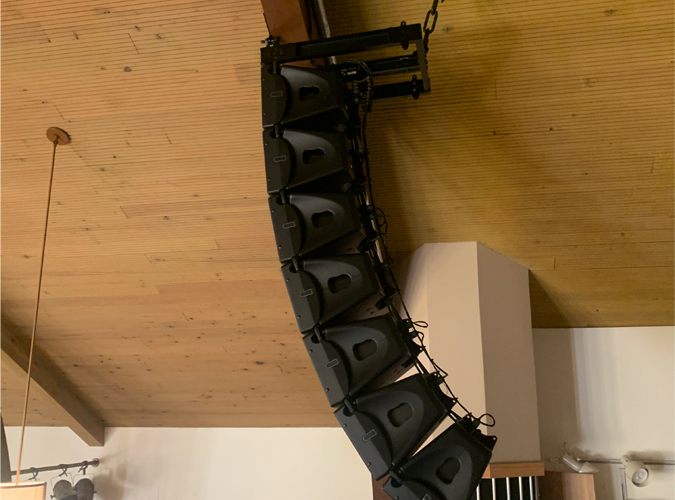
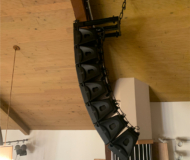
The original design called for six NEXO GEO M10 elements per side. But once the final hanging positions were established, the geometry demanded another solution.
“Having to fly it that high and still hit the front row required a seventh box,” Brearley says. “So I added a box and changed angles.”
The final design incorporated seven NEXO GEO M10 loudspeakers per side along with a flown cardioid subwoofer array, optimised using NEXO’s NS-1 modeling software.
The goal wasn’t simply to make the room louder. It was to make the room more consistent.
Rather than relying heavily on additional front fills or delay systems, Morgan Sound focused on achieving uniform coverage from the main arrays themselves. That distinction would ultimately become one of the most important measures of success.
Designing for Easter, Christmas – and everything after
ECC’s definition of “future-proof” went well beyond choosing equipment with a long service life. The church deliberately designed for its most demanding moments. “We typically design for what I would consider to be the heavy use cases,” Brearley says. “Design for Easter and design for Christmas.” In other words, don’t build the system for an average Sunday and hope it can survive the big ones. Build it for the big ones.
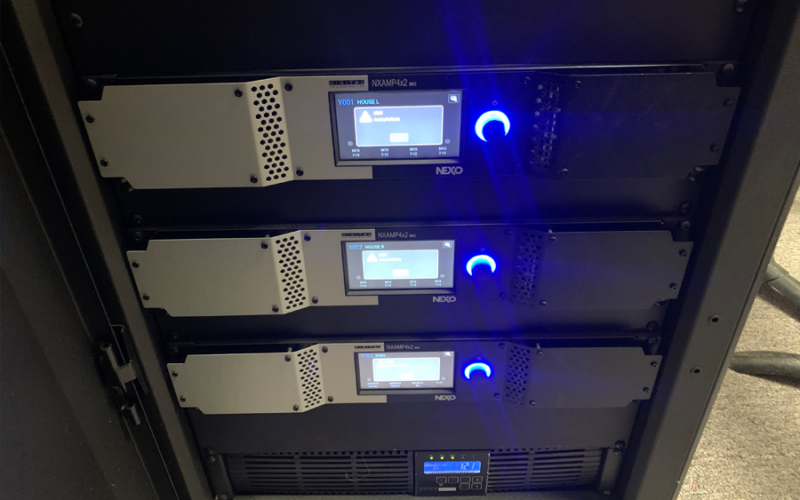
ECC expanded its wireless infrastructure, standardised routing and implemented Dante networking. The church also selected more console capacity than it typically needs on a weekly basis.
“Our console is a 64-channel console, and we don’t actually use all 64 channels all at once,” Tan explains. “But we did that so that we don’t have to re-patch anything.”
That may sound like a small decision. For a volunteer-driven technical ministry, it can be transformative.
The church was not designing around what it needed today. It was designing around what it might need next year, five years from now – or when the next generation of technical volunteers takes over. ECC had already demonstrated that mindset before the renovation. While the larger project moved through approval and budgeting, the church continued improving its infrastructure where it could.
Brearley noticed.
“They built their own Waves server and had that integrated with their console,” he recalls. “They were already doing super high-level stuff.”
Designing for volunteers who haven’t arrived yet
Perhaps the most compelling part of the ECC project has little to do with audio. It’s about succession.
ECC’s production ministry is entirely volunteer-driven.
“A big part of our DNA in our church is that we’re completely 100% volunteered,” Goh says. That changes the definition of a successful system. A system can be technically brilliant and still fail if only one or two people know how to operate it.
ECC wanted something different. “One of the things that Nathan and I were really hoping for is that even after Nathan and I move away or we’re not involved anymore with the AV team, that people would still be able to use that stuff,” Tan says. So simplicity became part of the engineering brief. “Just press one button, everything turns on and everything just works.”
Behind that simplicity is a considerable amount of thought.
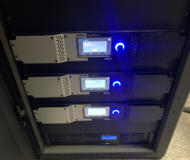
Morgan Sound implemented power sequencing, predefined workflows, fixed routing, amplifier presets, analog failover paths and scene-based operation. The complexity is still there – but it lives underneath the surface rather than in the hands of every volunteer.
“We really just thrive off using presets and show files and scenes,” Tan explains. “Most of the people, they just know how to turn things on and use them.”
For Brearley, the church’s technical volunteers were unusually capable.
“These guys are system-tech-level volunteers,” he says. “Once we got it configured together and they understood how it works, I don’t even have to worry about it.”
That’s an important distinction.
ECC didn’t build a system that eliminates expertise.
It built a system that doesn’t require every volunteer to have it.
The walk that changed everything
The real test came when the system was commissioned. Instead of simply listening from the mix position, the team walked the room.
Back and forth down the aisles. Listening. Comparing. Moving.
And then something happened that had rarely happened in the old system.
The room sounded the same.
“We were just walking back and forth down the aisle,” Tan recalls. “We were like, wow, it sounds exactly the same. Honestly, it was mind-blowing.” For Goh, the result could be summed up in a single sentence: “The biggest instant change was having everyone hear the same thing.”
That meant more than consistent SPL. Speech became more intelligible. Musical reproduction became more balanced. And the low end finally delivered what the contemporary service demanded.
“We finally could hear the bass for the first time,” Goh says.
At the same time, the system proved equally comfortable with more traditional material.
“The acoustic piano through the NEXO PA sounds so good,” Brearley says.
That flexibility is particularly important in a room that can move from choir and piano to a contemporary worship band – and then bring multiple languages and congregations together.
When success becomes boring
Perhaps the best measure of the project came later.
Not during commissioning.
Not on opening Sunday.
But after the novelty had worn off.
More than a year after the installation, ECC had made almost no changes to the PA.
“The only change they asked was a little bit more headroom to the subs,” Brearley says. “It’s been over a year since they’ve asked for any audio changes on the PA.”
That’s a remarkably quiet endorsement for a technology project. But perhaps that’s exactly the point.
ECC’s original goal was distraction-free worship.
The new system doesn’t call attention to itself. It doesn’t force the English congregation to work around the needs of the Mandarin congregation – or vice versa. It doesn’t require volunteers to become system engineers before they can run a service. And it doesn’t limit what the church can do next.
Instead, the infrastructure quietly creates conditions for everything else to happen.
“Coverage was probably our top priority,” Tan says. “And now everybody hears the exact same thing.”
Three congregations. Multiple languages. Different musical traditions. One room. One shared experience.
And a technology platform designed to serve not only the people standing on the platform today, but the people who will stand there years from now.
For ECC, that’s what future-proofing really means.
Not buying more technology. Building a foundation that gets out of the way – and lets the ministry take center stage.
