





















Custom audio system balances speech clarity, liturgical music and architectural beauty
In a striking sanctuary known for its reverberant acoustics and wraparound seating, St. Frances Cabrini Catholic Church and AcousTech deployed a custom NEXO/Yamaha system that celebrates the full depth of worship while balancing speech intelligibility, Liturgical Music, and architectural beauty.
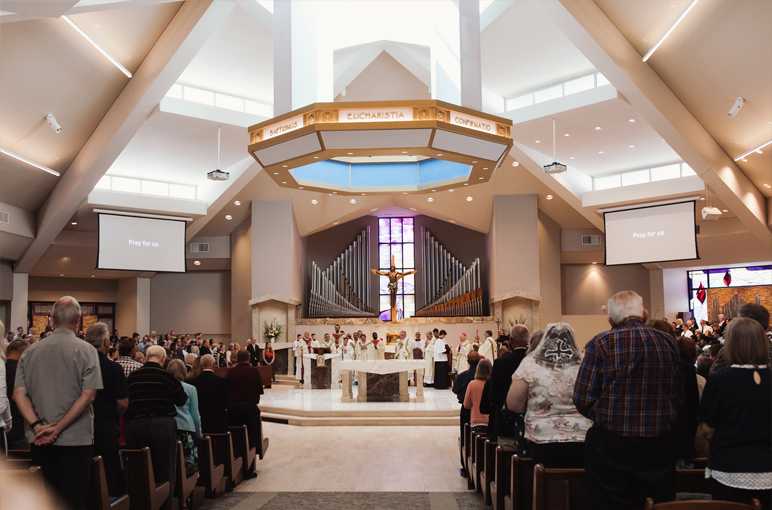
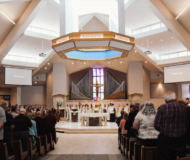
Designing sound reinforcement for houses of worship often requires striking a delicate balance between architectural aesthetics, Liturgical Music, and speech intelligibility. At St. Frances Cabrini Catholic Church in Littleton, Colorado, that challenge was amplified by a sanctuary unlike most others – a highly reverberant space with approximately 270° seating surrounding the altar, a large pipe organ, and architecture designed to celebrate traditional sacred music.
As part of a major sanctuary renovation known as the Heartbeat Project, church leadership sought more than a new sound system. The goal was to create a more sacred worship environment while ensuring that every homily, scripture reading, and Liturgical Music could be clearly heard by the parish’s nearly 3,500 families.
To accomplish that, the church partnered once again with AcousTech president Roland Dutzmann, whose firm has specialised in worship spaces for nearly four decades.
“We’ve been working together for a long time on various projects,” said Tyler Tracey, Pastoral Associate of Mission and Strategy at St. Frances Cabrini. “When this project came up, really, we didn’t even go to anyone else. We were like, ‚Roland’s the guy.’”
Solving a longstanding challenge
Although the renovation centered architecturally around the Eucharist, it also presented an opportunity to address an issue that had existed since the church opened in 1998.
“It’s a beautiful space, great reverb, wonderful for choir and organ music, but spoken word was very hard to hear,” Tracey said.
Parish pastor Fr. John Paul Leyba saw the same challenge. “Because the church’s original design prioritized musical and choral acoustics, speech intelligibility suffered from excessive reverberation, which reduced the clarity of the spoken word. Our goal was to improve speech clarity without compromising the existing musical experience.”
For Tracey, success could be measured simply. “What matters most is that people can hear. If they can hear the priests speak, hear the readings, hear the music clearly, that’s the sign of success.”
Modeling before installing
Few worship environments present the combination of acoustical and architectural constraints found at Cabrini. The wraparound seating, elevated reverberation time, off – center music positions, prominent organ pipes, and liturgical sightlines all influenced loudspeaker placement and system design.
“Churches have unique needs,” explains Dutzmann. “You can’t just take a generic PA system and expect it to work.”
Rather than designing around assumptions, AcousTech spent significant time modeling the room in NEXO/Yamaha’s NS-1 prediction software.
“Yamaha generated the NS-1 Venue space from AutoCAD architectural drawings we provided”, Dutzmann said. “From there I spent 40+ hours exploring different speaker system arrangements and components to achieve an optimal balance of even coverage and aesthetics within the room.”
The modeling process allowed the team to compare four different system concepts during the design phase of the project. “The challenge was creating sound that emanates coherently from center of the space for speech as well as from the front, off-set, music/choir area. For the chosen concept, we coordinated closely with Eidos Architects and general contractor Horizon West Builders to integrate the system into the architecture while preserving the sacred aesthetics of the space they had so beautifully designed.”
The team also resisted the temptation to overtreat the room acoustically. “We treated the areas that really mattered,” Dutzmann explained. “The goal wasn’t to kill the room. We wanted to create acoustics that still retained ‘life’ without sounding cavernous.”
Separate systems for speech and music
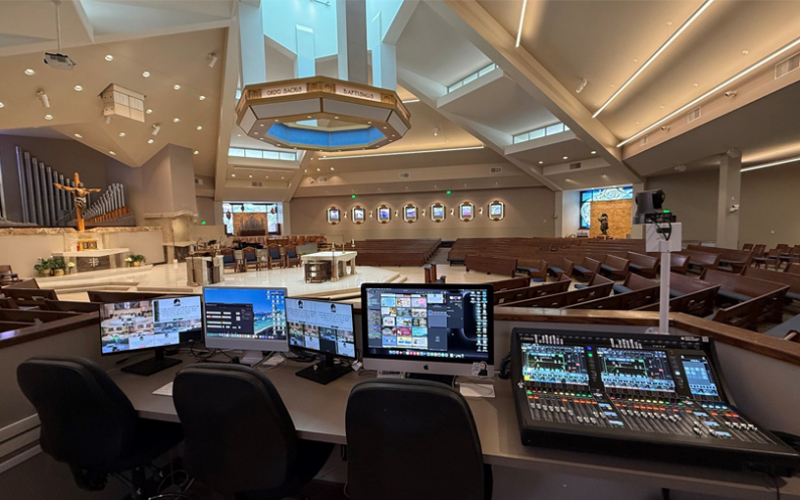
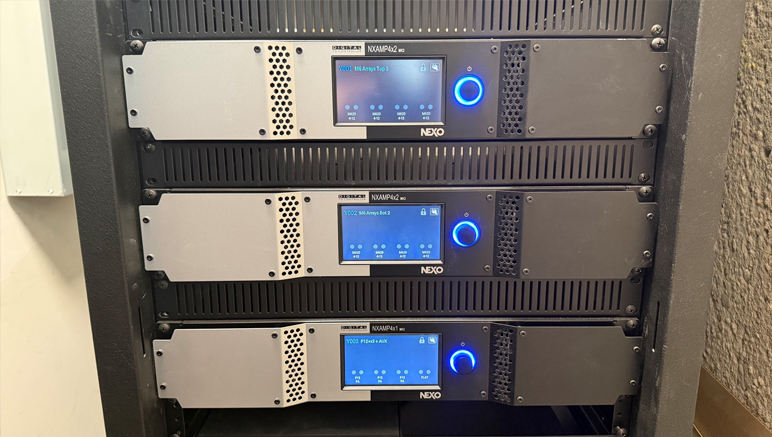
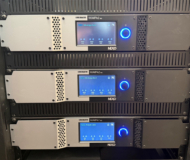
The completed system combines NEXO M620, P12+, M1012 and M1025 loudspeakers plus MSUB18 Subwoofers powered by NEXO NXAMP amplifiers with a Yamaha DM7 console and dual Rio 32×16 stage boxes.
Rather than asking one reinforcement system to do everything, AcousTech developed separate systems optimised for speech and music. “We essentially created two systems in the same room,” Dutzmann explained. “Speech and Music sources are well localised from the visual point of origin at all seating areas.”
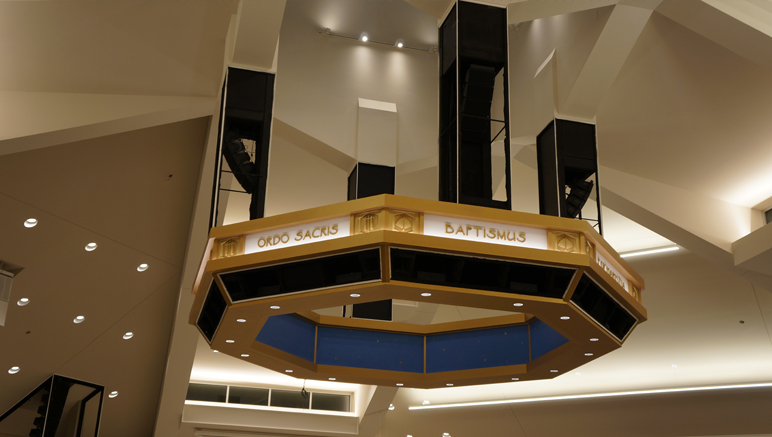
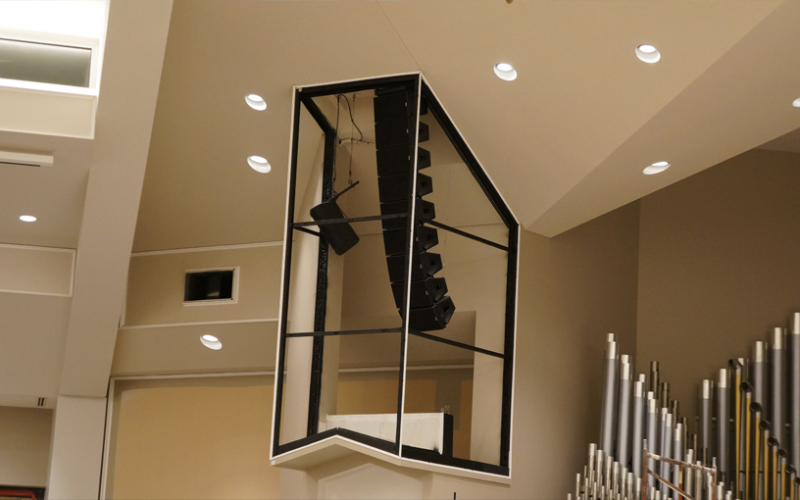
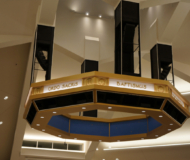
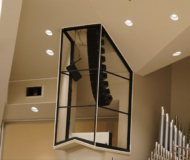
Four vertical arrays built around NEXO M620 loudspeakers provide highly controlled coverage for spoken word, while separate M12 and MSUB18 speakers handle musical reinforcement. P12+ loudspeakers provide additional fill coverage for difficult seating areas.
Coverage consistency was a primary design objective. “We ended up within about 2dB from front to back over roughly 95 feet,” Dutzmann said.
Dutzmann also credits the NXAMP platform with simplifying commissioning. “I run everything off the NEXO amps,” he said. „The Mark II amplifiers are much easier to work with and program, and all the tuning is done right in the amplifiers.”
Designed to disappear
Integrating the loudspeakers into the sanctuary proved almost as challenging as designing the system itself. “There were organ pipes, the crucifix, sightlines – lots of things we couldn’t interfere with,” Dutzmann said.
Loudspeakers were concealed within architectural elements behind acoustically transparent materials, allowing the technology to remain largely invisible.
“People shouldn’t be looking at speakers,” Tracey said. “They should be focused on worship.” That understanding of church environments is one reason Tracey says Cabrini has continued working with AcousTech for more than a decade. “Roland has a reputation of just being excellent across the diocese,” he said. “Churches rely on Roland to bring excellent sound, but he also understands the things that matter to churches, like aesthetics.”
Supporting every service
The sanctuary supports everything from traditional liturgies featuring one of Colorado’s largest pipe organs and choirs to contemporary worship services with a full band.
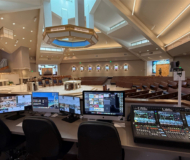
At the centre of the system, Yamaha’s DM7 routes independent speech and music buses while also supporting eight channels of wireless in-ear monitoring and additional personal monitor systems for musicians.
Despite its sophistication, the operational philosophy was intentionally simple. “It’s really a set-and-forget system,“ Tracey said. „Our volunteers don’t have to fight it. It just works.” „The fewer things volunteers have to touch, the better,” Dutzmann added.
Commissioning reflected that simplicity, requiring only a few hours of tuning with virtually no significant changes after installation.
Measured by the congregation
Ultimately, the project’s success wasn’t measured by modeling software, SPL data, or system performance, it was measured by the congregation. “People say, ‘We can hear the priests. We can hear the readings. We can hear the music clearly.’ That’s success across the board,” Tracey said.
Father John Paul Leyba, whose RF engineering background made him especially attentive to system performance, admitted he approached the project with cautious skepticism. “Congregational feedback – no pun intended – has been that the new audio system and acoustic paneling successfully achieved those goals.”
For him, that success extends well beyond technical performance. “Although the Eucharistic Sacrifice is the source and summit of Catholic life, the importance of clearly hearing and understanding the Scriptures and the homily in forming and inspiring the Christian life cannot be underestimated.”
Dutzmann received his own confirmation after the Dedication and Consecration Mass. “Father John Paul came to me afterward and basically said, “Roland, you succeeded in what we’re looking for.”
In a sanctuary where architectural beauty, musical excellence, and speech intelligibility have long competed with one another, the completed system demonstrates that thoughtful acoustical modeling, careful loudspeaker design, and close collaboration between the church, architect, and integrator can successfully balance all three. The result isn’t simply a new sound system, it’s a worship environment where the technology quietly disappears, allowing every word, every note, and every seat in the sanctuary to share the same experience.
